
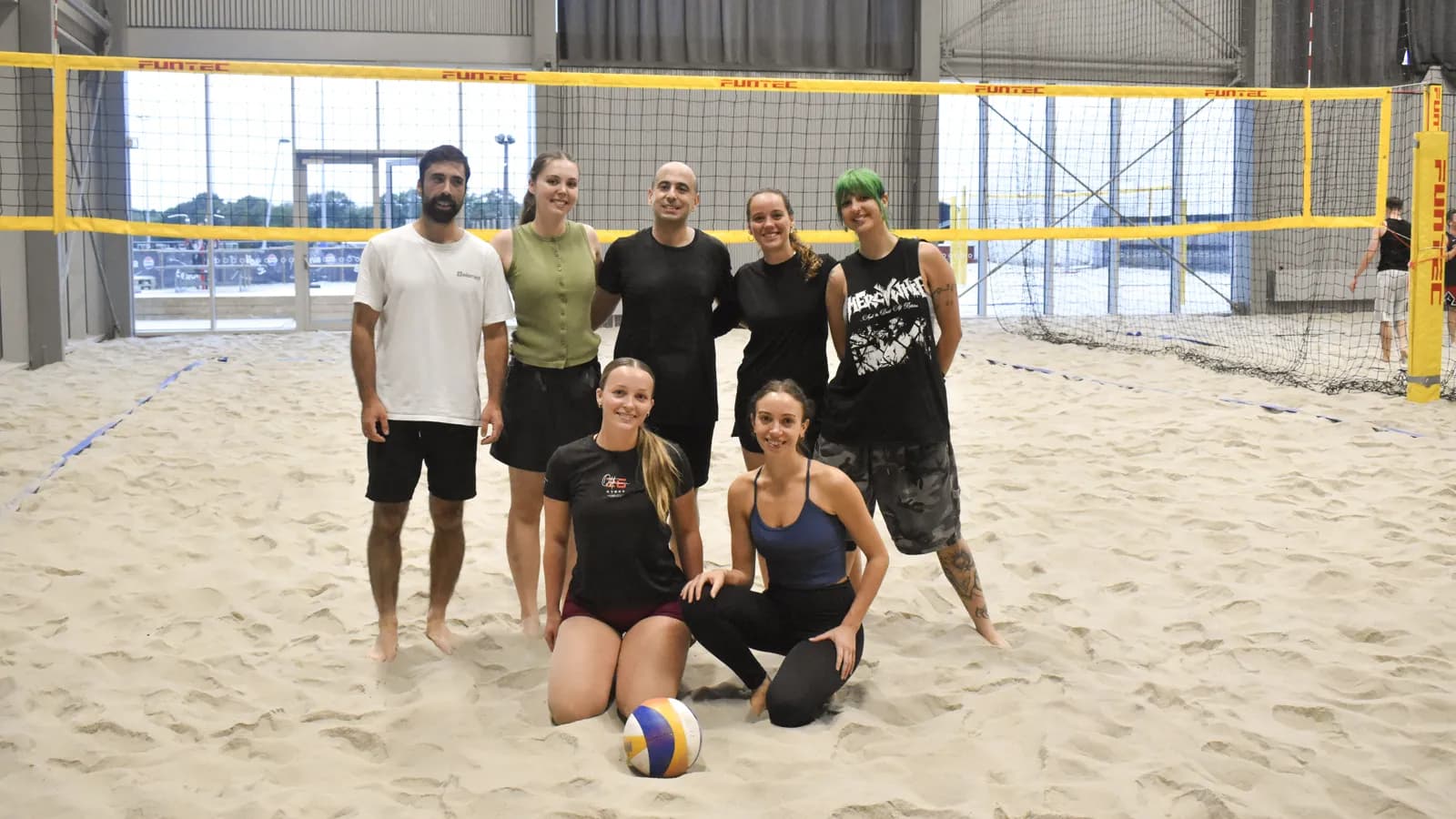
Social sports means playing a sport for fun and to meet people in organised games you can join alone, without a membership, a team or a season. A sports club is built around regular training and competition, while a social game is a single evening you sign up for and pay for on its own.
- Goal: have fun, move and meet people, not win a league.
- Who can join: anyone, alone or with friends, at any level.
- Commitment: none. You pick a game, you pay for that game.
- Who organises: a host books the court or pitch and brings the group together.
- How to join: find a game in the app, take your entry and show up.
What are social sports, and do I need a team?
Social sports is a simple idea: the game is the excuse, the people are the point. You play padel, football, volleyball or badminton with a mixed group, and everyone is there to enjoy it. Nobody expects you to be good, and nobody expects you to know anyone.
Most games are one-off sessions. There is no team to join, no season to sign up for and no training schedule to keep up with. If you want to play three times next month, you join three games. If you are busy, you skip a week and nothing happens.
It suits people who have just moved to a city, people who finished university and lost their team, and anyone who wants to exercise without doing it alone. If you have searched for sports to meet new people, this is the format built for that.
How is social sports different from a sports club?
- Membership: clubs usually charge a yearly or monthly fee. Social games have no membership, you pay per game.
- Season and training: clubs run seasons with fixed training days. Social games are one evening at a time.
- Team: clubs have fixed teams. In social games the host mixes the groups, so you can play with different people each time.
- Competition: clubs often play in leagues against other clubs. Social games are friendly.
- Level: clubs often expect a certain standard or a tryout. Social games welcome all levels, and the host mixes players of similar level where a level is set.
- Joining alone: in a club you usually join a team and wait for a place. In social sports, coming alone is the normal case.
Neither is better. A club is great if you want to train, improve steadily and compete. Social sports is better if you want flexibility, new faces and a low-pressure start. Many people do both.
What are the other ways to find people to play with?
If you want to join a social sports team alone, you have several options, and each has a catch.
- Forums and partner-finding sites: you post that you are looking for players and wait. It can work, but replies are not guaranteed and you still need to book the court yourself.
- WhatsApp groups: good when the group is active. Many fade out after a few weeks, or end up with players at very different levels.
- Beginner courses: a good choice if you want coaching and to learn the basics. They are about training more than about meeting a changing group.
- Leagues: fun if you want to compete, but they usually need a team and a commitment for a whole season.
- Clubs: best for steady training and a long-term team.
A hosted game is easier when your main goal is to start playing this week. A host has already booked the venue, found the other players and set the level, so you only choose a game and turn up. The same applies if you organise a game with friends: someone has to find players, pay for the court and chase cancellations. A host does that work for you, and the group includes new faces.
What does a host do?
The host is the person who makes a social game work. A host books the venue, sets the date and time, brings the group together. They also set the level of the game, so a beginner does not end up on court with advanced players,.
athme works with 100+ hosts. You can read more about them on the community page.
How does it work on athme?
athme is a social sports app. It runs hosted games in 7 cities in 4 countries: Copenhagen, Aarhus and Odense in Denmark, Malmö and Lund in Sweden, Bratislava in Slovakia and Valencia in Spain. There are 8,000+ users from 100+ nationalities, and 44% of players play again the next month.
The sports include padel, football, volleyball, badminton, basketball, handball, pickleball, table tennis, bouldering and fitness. Which sports run in which city changes, so check the app for this week's games.
- Download the athme app.
- Browse upcoming games in your city and pick a sport and level.
- Take your entry and pay in the app. The average paid ticket is €11.
- Show up. The host does the rest.
A cancellation window applies, so if your plans change, cancel in the app in good time. For more answers see the FAQ.
Questions people ask
- What counts as a social sport?
- Any sport played mainly for fun and company rather than competition, in a relaxed format with no membership. Padel, football, volleyball and badminton are common examples.
- Do I need to bring a team or a friend?
- No. Many people come alone. The host brings the group together, so you only need to take your entry and show up.
- What if my level is lower or higher than the others?
- The host sets a level for the game and mixes players of similar level where a level is set. Beginners are welcome.
- How is a hosted game different from a club training?
- A club training is part of a season with a fixed team and a membership. A hosted game is a single evening with a mixed group, and you pay only for that game.
- Can I try once without signing up for a season?
- Yes. You join one game, pay for that entry in the app and decide afterwards whether to come back.